Unlike traditional average rate indices, which can be misleading due to their flawed composition, the LendZen Index tracks the change in mortgage rate PRICES across a spectrum of mortgage bonds.
This approach offers borrowers a clearer understanding of how the cost to obtain a mortgage changes daily, irrespective of the specific rate they are considering.
The LendZen index also puts into context how quickly previous rate quotes can become obsolete, and in some cases by how much.
For example…
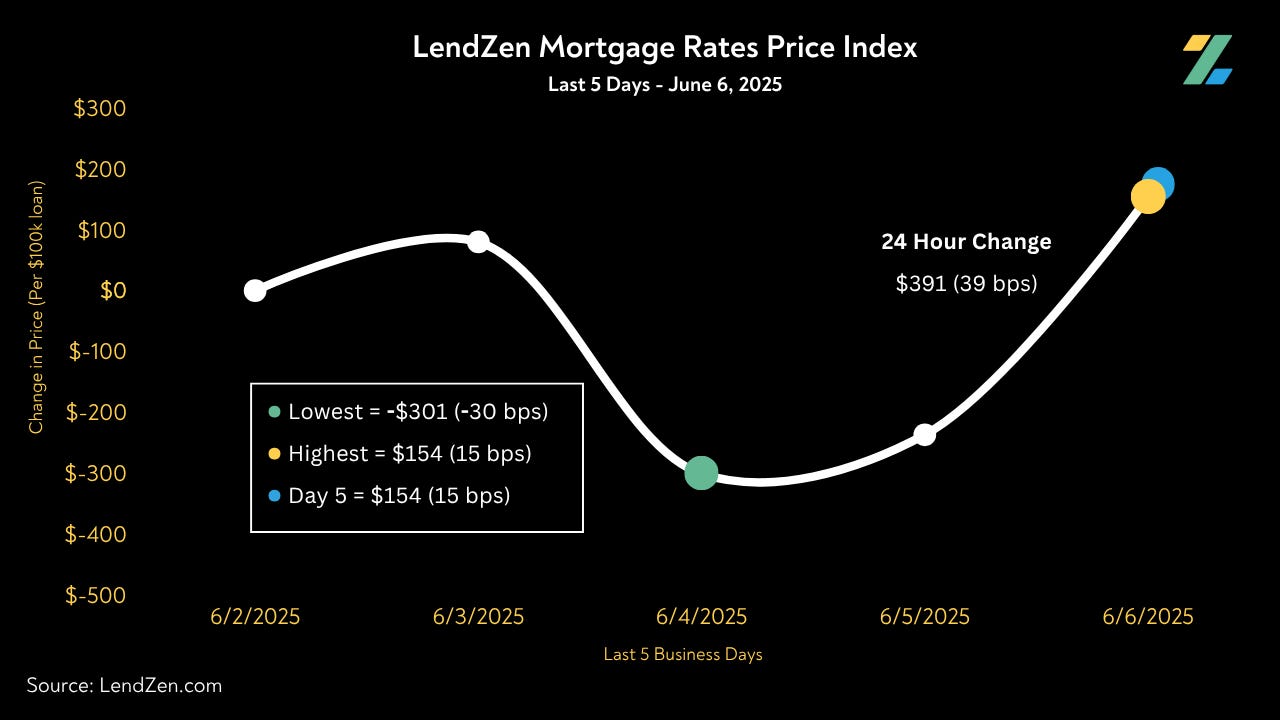
Friday's bond market reaction to the Non-Farm Payroll employment report pushed the cost of mortgage rates higher 39 basis-points, or $391 per $100k.
This means any rate quote received on Thursday is now more expansive by 0.39%.
That might not sound like a lot, but for a $500k loan amount it represents an almost $2,000 increase in a single day.
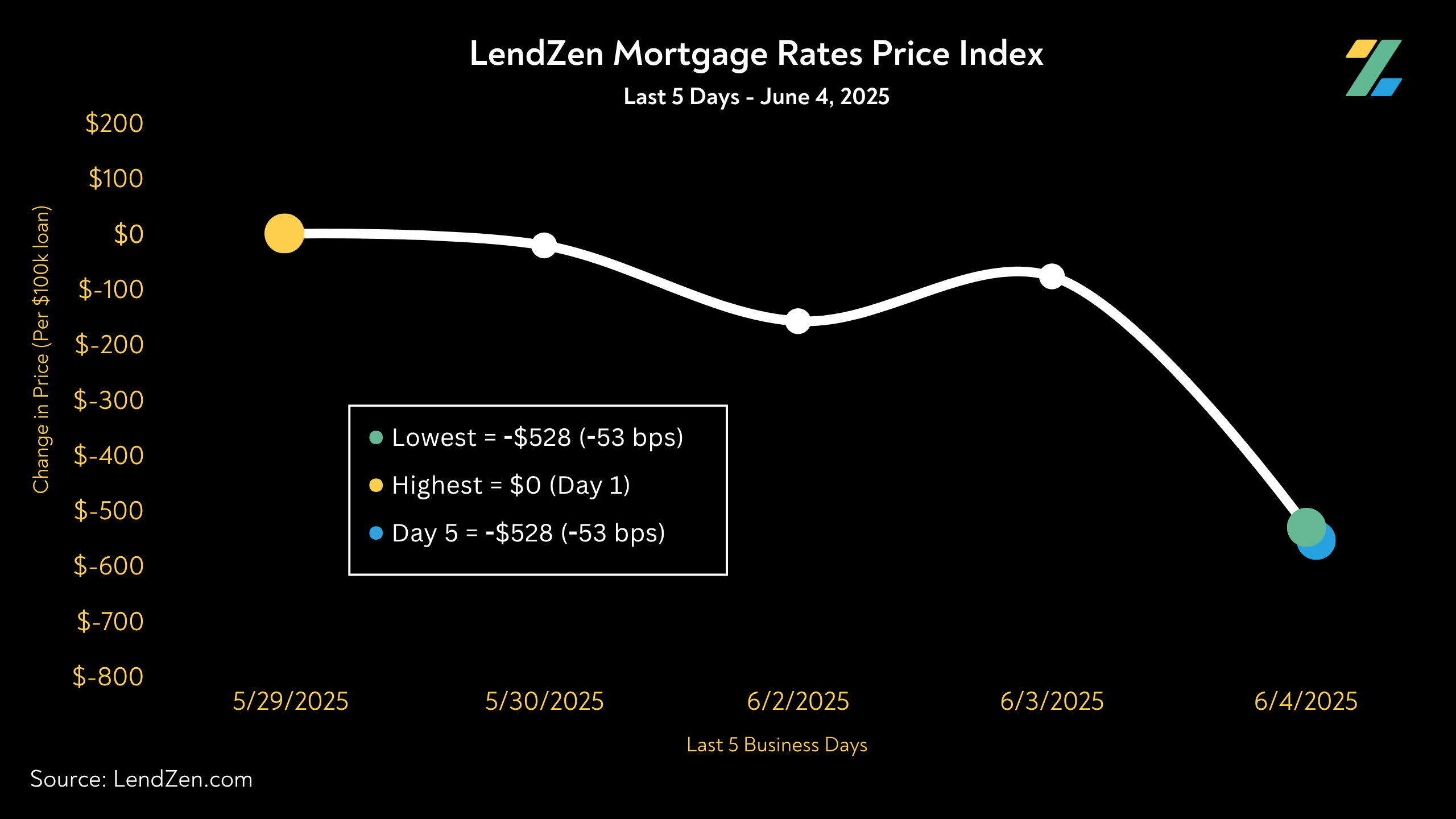
Friday's move higher followed the BIGGEST daily improvement for mortgage rates in over a month just two days prior.
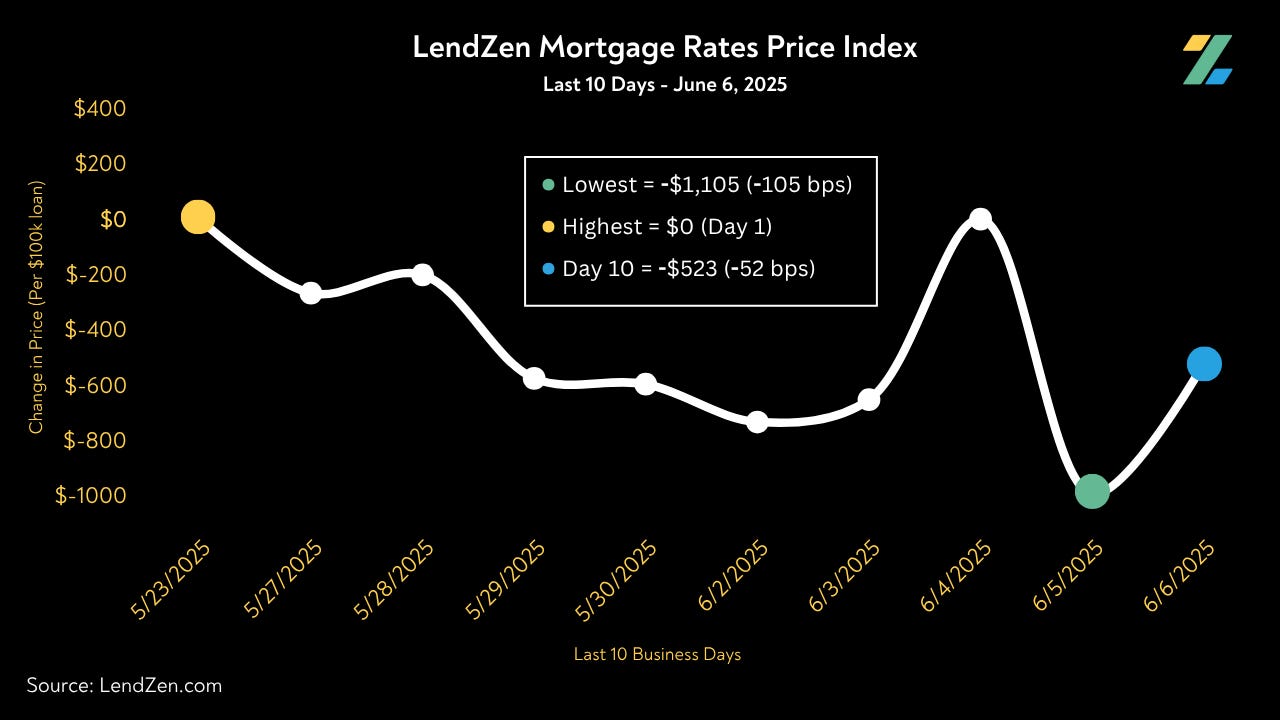
The "Last 10-Days" chart below helps visualize this recent volatility, while putting the last two weeks into perspective.
During that time the cost of getting a mortgage has declined 52 bps.
The LendZen Index tracks the change in mortgage rate prices across a spectrum of MBS.
That is because in the USA mortgage rates do not rise or fall. Instead, the cost of each rate changes based on the daily fluctuation in the price of mortgage bonds (MBS).
There are many factors that influence the demand for bonds, but what’s important to understand is how a lack of demand results in less capital bidding for each mortgage-backed security (MBS).
This pushes the price of each bond lower, and the cost of mortgage rates higher.
The LendZen Index helps to both visualize and quantify the inverse relationship between bond demand and mortgage rate price.
It also helps emphasize the point I make regularly about so-called “higher” mortgage rates:
“It is not that lower rates are suddenly unavailable, it’s that the cost to get a loan at those lower rates is no longer economically feasible for borrowers to pay. As a result, lenders refrain from promoting them.”
Mortgage bonds are a very similar investment to U.S. Government Bonds.
However, government bonds vary based on duration (length of time), whereas mortgage bonds vary based on the offered rate (coupon).
Therefore, demand for government bonds is measured by the change in yield (rate), whereas mortgage bond demand is measured by the change in price.
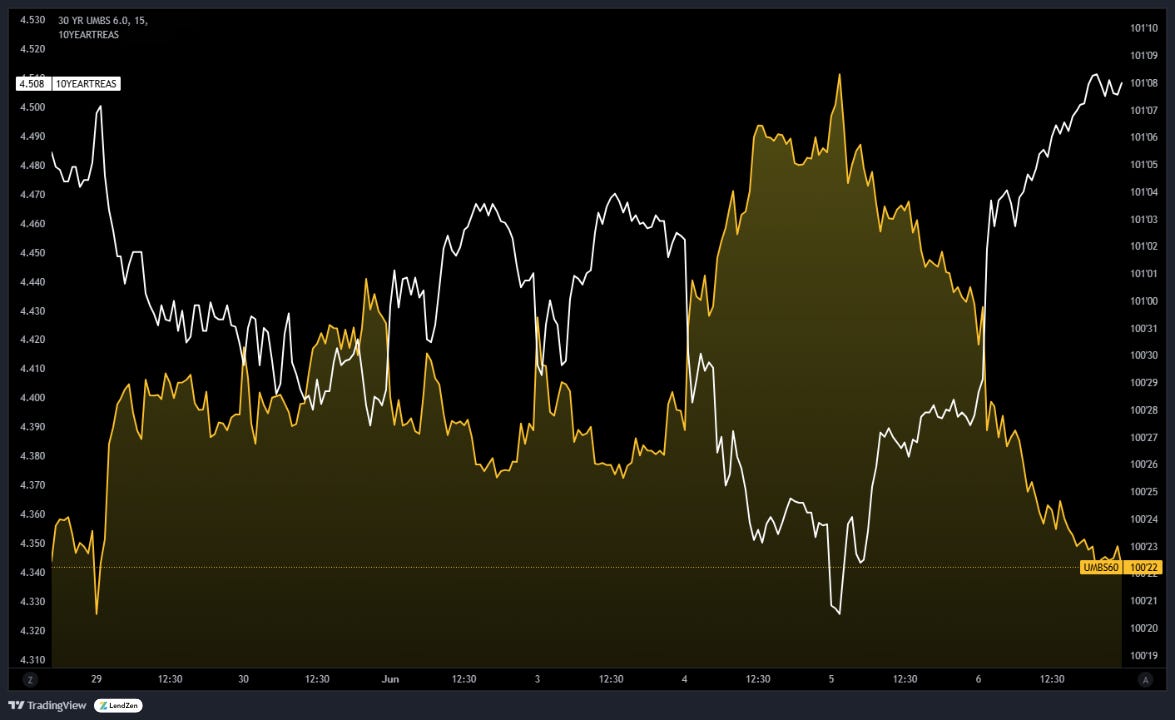
This is why the RATE of the 10-year Treasury Bond shows an almost perfectly inverse relationship to the PRICE of mortgage-backed securities.
Want to check customized, real-time mortgage rates instantly?
LendZen gives you anonymous access to mortgage rates that update as bond prices change.
Get full transparency of costs upfront and instant qualification results without any signup or human interaction required.
See for yourself and customize your own loan scenario at LendZen.com
(NMLS# 375788)